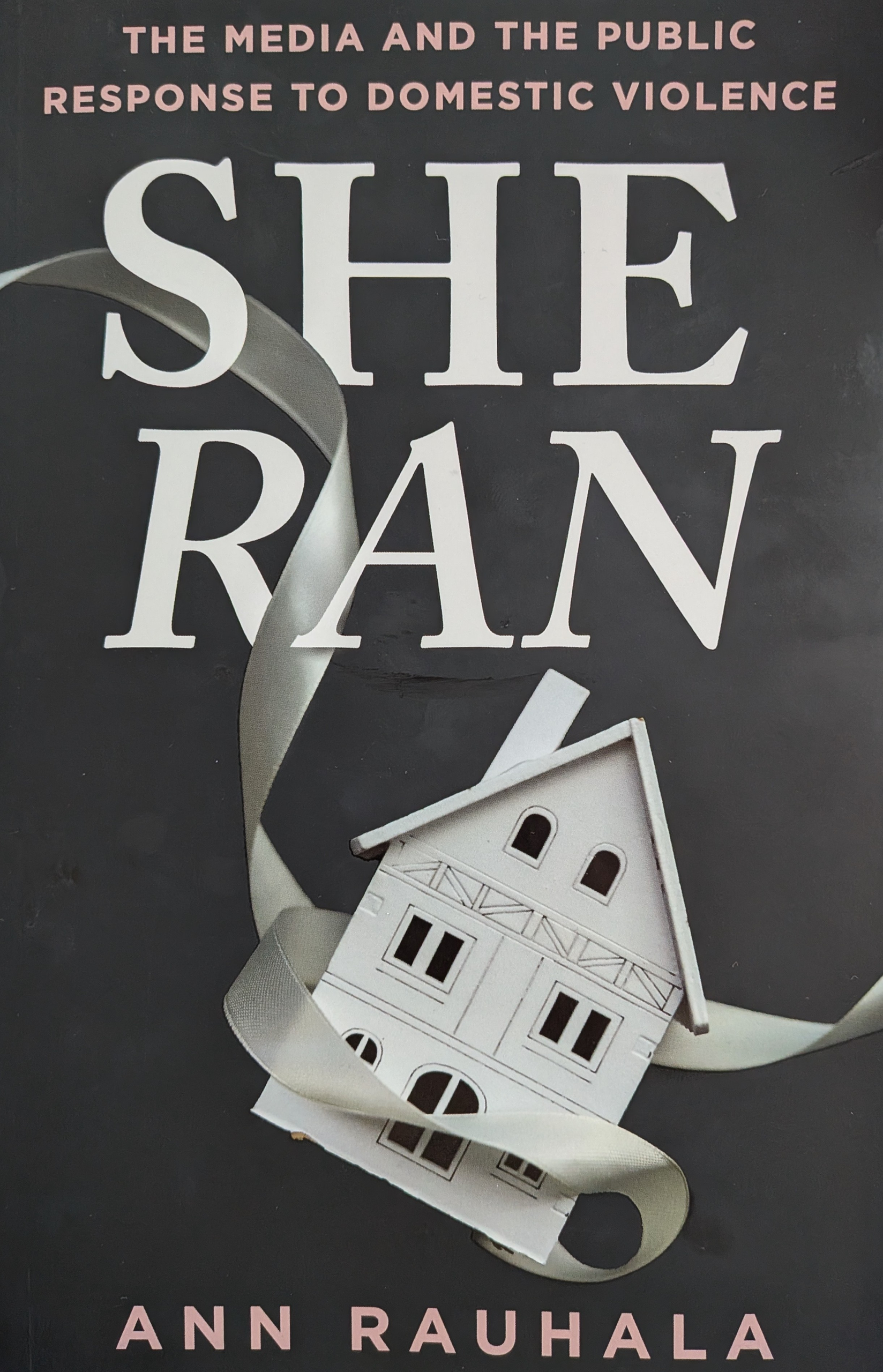
Here we have a new book about intimate partner violence (IPV), media coverage of it – mostly critical, and the author’s own personal story about her friend Donna who was viciously killed by her ex-boyfriend in the 1970s in Sudbury. It’s inappropriate to say I enjoyed a book about such a serious topic. However, I’ll say I did because learning is a form of enjoyment.
I happened to have been at the book launch for She Ran. The author, Ann Rauhala, is married to my mom’s first cousin, Lorne. I don’t know what that makes us – second cousins once removed? With Ann having worked at the Globe and Mail, CBC and Ryerson University (now TMU), the room was filled, as one might expect, with journalists. Ann used her background as a journalist, journalism professor, and friend of Donna to create this interesting subject that has rotated through many ‘titles’ over the years. Intimate partner violence really does seem like an accurate description, much better than oudated wife abuse.
It’s clear from very early on that it’s a personal book. I prefer it when a journalist breaks through the objectivity of reporting the story and becomes part of it, as in Carol Off’s All We Leave Behind, in which she gets involved with the family of a source (who became vulnerable because of the contents of what he shared) she had in Afghanistan, helping them come to Canada. Ann, too, makes the decision to jump from reporter to reporting human who has a stake in the outcome of the investigation.
Donna Evoy and Ann were friends growing up in Sudbury. Though they didn’t go in the same direction for university, they kept in touch. Donna was horrifyingly shot in December, 1975 by a boyfriend with whom she had just broken up. He killed himself at the scene. Donna apparently ran from her seat in his van. Ann held on to Donna’s memory as she navigated life and relationships in the city (Toronto) as a student and adult, including her own experiences with previous partners.
In her investigative journey, Ann spoke to people in Sudbury who were knowledgeable about the scene of Donna’s murder – where she got out of the ex-boyfriend’s van and ran, only to be shot in the back, and then, and once again as she lay on the ground. Ann also spoke to one of Donna’s brothers who revealed that there had been abuse present in the family household. This Ann had not known.
As a good journalist, Ann spoke to many sources familiar with IPV, including lawyers who detailed the many shortcomings of the justice system, activitists with personal experience, police officers who had carved out careers re-shaping police institutions and officers to be more supportive and proactive, and, of course, survivors whose stories help to shed light on the patterns that should be familiar now to many people. Though it contains statistics, of course, the book is not cold and impersonal. Statistics always come to life with interviewees’ personal stories and experiences. And they all connect back to Donna.
One aspect I really respect about the book is the attention paid to how young men might be getting lured into toxic so-called Manosphere. This needs more study in order to take a preventative stance. I thought Ann’s interviews with representatives of White Ribbon, a campaign “engaging men and boys as allies to promote gender equality,” were insightful.
I also respect Ann for including a series of checklists – or “Risk Lists” toward the end of the book. Some of the checklists are geared toward police officers and nurses or other professionals, and are comprised of carefully chosen questions that can be posed to women who are suspected of being in abusive situations. The risk factors have been well researched, so these tools can help. Other tools can be used by bystanders, friends, supporters, teachers, etc. Not surprisingly, Ann also includes standards for journalists in terms of Dos and Don’ts as one of her major themes is that media can play a more positive and helpful role in counteracting and maybe preventing IPV. Her point is that people who report should be familiar with the vast social, economic, and human eco-system in which they and their subjects exist.
Ann’s vantage point is wide because of the career path she has taken. From journalist at the Globe and Mail, editor at the Globe, covering women’s issues at the Globe (for a short but crucial time), editing the foreign section of the paper, working for CBC, then going into teaching journalism at Ryerson (TMU). Her career has challenged expectations for women. This link from TMU highlights all of her many achievements and contributions.
Normally I email an author after I finish their book. In this case, I got to chat with Ann about the book in person as she and Lorne kindly invited Val and I to dinner. I saw her passion, got to hear a little bit about the process of piecing the book together during Covid, and heard how we had something in common in supporting young people toward achieving their goals.