On Savage Shores: How Indigenous Americans Discovered Europe.
By Caroline Dodds Pennock (2023)
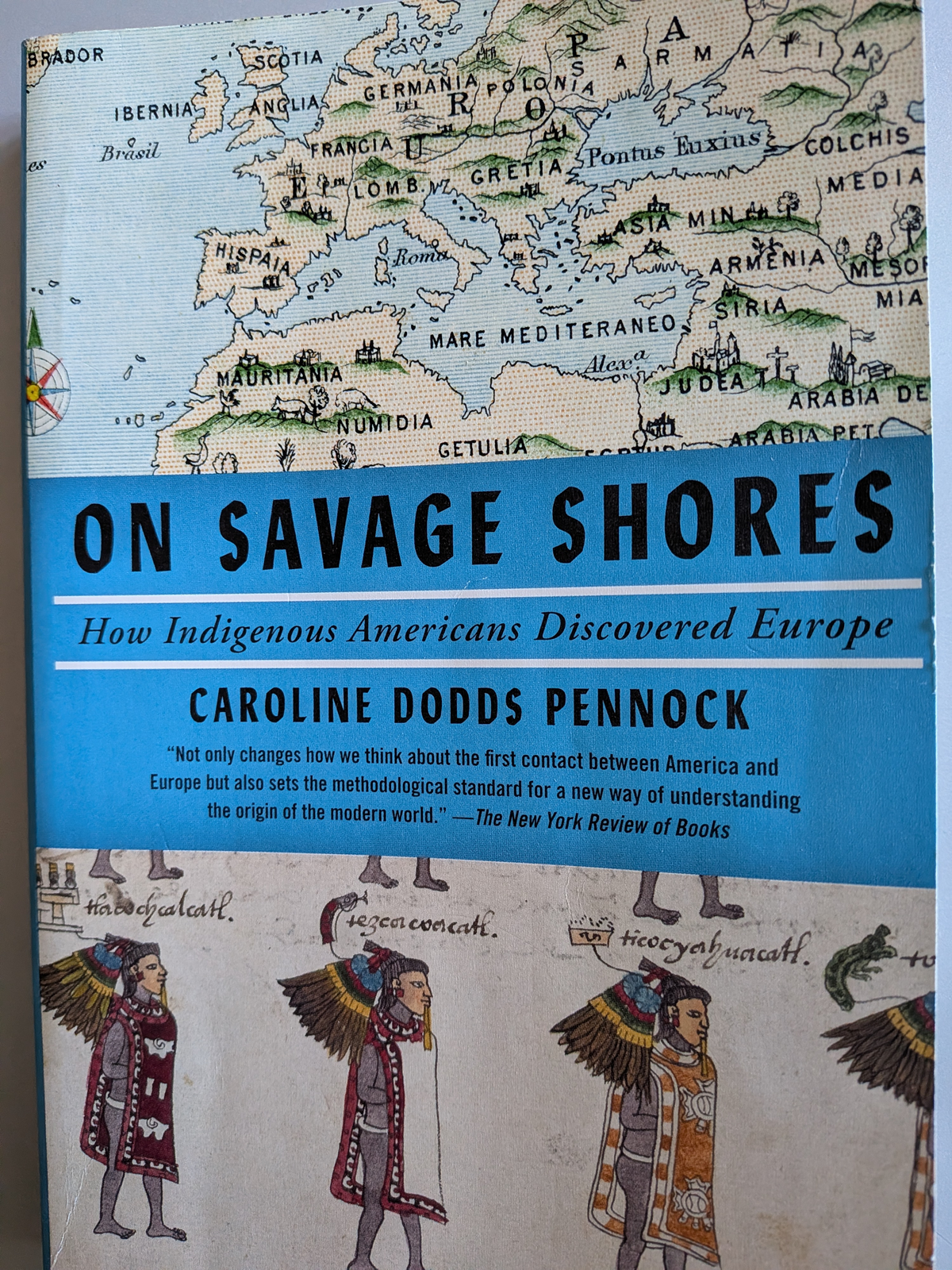
What an incredibly eye-opening book! Received as a retirement gift, this book almost tempts me to return to the classroom to re-do my lessons on the Aztecs.
Students in grade 12 World History classes over the years would consistently have two questions:
1. after learning that Columbus “took” – meaning kidnapped – Indigenous people from Cuba back to Europe with him after his first voyage in 1492, they always asked, what happened to the people?
2. after learning that Hernan Cortes had a son with his translator, Malinztin, they asked: what happened to the child?
I never really had any answers for these questions. Now I do.
On Savage Shores addresses the trans aspect of the trans-Atlantic relationship between Spain, Portugal, France, Britain and their colonies in the Americas starting in the late 1400s.
Yes, there was kidnapping, in abounding amounts; people were enslaved and brought to Europe. Columbus did it in the Caribbean, Vicente Yanez Pinzon did it from the Amazon to Spain, Gaspar Corte de Real did it from Maine to Portugal, the Portuguese took Tupi people from what is today Brazil to Portugal, Jacques Cartier stole Iroquoians to take to France, more Tupi and other people were sent to France, Martin Frobisher took Inuit, and more.
The book investigates Indigenous people who ‘went the other way’ whether by choice or not. In total, they might have numbered 10 000, a not insignificant figure.
Sometimes Indigenous nobles chose to go to Europe looking to establish relations with royalty in order to advocate for their people and for themselves. They endeavoured to build strong ties to colonial rulers and to emphasize their Christian loyalty. The book traces experiences and journeys of such “Americans”, and how Europeans received and reacted to them. Most critically, it centres Indigenous agency which can easily get written out of history, as seen in this quote:
“But whether accidental diplomats – victims of kidnapping who ended up speaking for their people – or voluntary ambassadors seeking redress for grievances, promoting their familial, local or individual interests, or simply seeking assurances or information from a distant ruler they had never met, these Indigenous politicians heped to shape European society and its transatlantic dealings as a conspicuous minority at court and in imperial hubs.” (p. 200).
It boggles my mind that during my 28 years of teaching World History I didn’t consider this perspective. There is a small taste of historiography in the book; I find it fascinating the lengths historians have gone through, making their way through archives, mostly in Spain, to find glimpses of the lives led by Indigenous people who stayed in Europe, some who travelled back. Of course many lives were lost very soon after arrival due to lack of immunity to European diseases. The book ends with a very sad story of a young Inuit buried in a churchyard in England.
This book also further strengthens my deepening awareness of global connections in the early modern history period. On Savage Shores relates to previous books I’ve read, such as Mairi Cowan’s The Possession of Barbe Hallay: Diabolical Arts and Daily Life in Early Canada, which explores women and witchcraft in Quebec in the 1600s and Quebec’s connections with the world. These are also prominent in the case of Marie-Joseph Angelique in Afua Cooper’s The Hanging of Angelique about an enslaved woman who, most notoriously, was accused of burning down Montreal. In reality her story is very complicated and Cooper reconstructs it using legal records. Last year (for my very last class, in fact) I built upon a lesson my student teachers had created about Angelique with a focus on her being an enslaved woman. I selected quotes relating Angelique’s experience to the slave trade, that trans-Atlantic jauggernaut, and to the Code Noir, French laws on slavery, which applied in Quebec. The 17th century world was actually smaller – more closely tied together – than we imagine it might have been in our technologically glorified way of making the 21st century seem so global.
For Indigenous people from North, Central, and South America, while going to Europe was often under very difficult circumstances, some made the choice to go and stay, such as Martin, son of Hernan Cortes and Malintzin. Apparently Aztec Emperor Moctezuma’s daughter, Isabel, had descendants that formed a dynasty that still exists in Spain.
The author emphasizes an aspect of the trans-Atlantic relationship that is not too unfamiliar: exoticism. Students familiar with Worlds’ Fairs where ‘curious’ people were put on exhibit for the benefit of Europeans (and Americans) will recognize such spectacles. Toward the end of On Savage Shores, Professor Dodds Pennock describes a French iteration of this in Rouen where these was a ‘simulated’ village and battle featuring Tupi from Brazil. She also contextualizes it by placing it in time just as France was trying to justify its colonization of Brazil.
As I always do when I read a fantastic book , I emailed the author to thank her. She replied and told me she was working with many teachers in the UK.
Thank you to Chris and Mairi for this enlightening book. When I get to updating the teaching materials on this blog I shall be sure to incorporate this new knowledge and perspective.