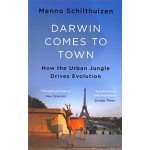
Who knew a book about urban evolution could be so amusing? I would have said not me, but I must have had an inkling because I picked this book off the remainders table at my local Book City. Likely it was my interest in Darwin that captured me. I’m a sucker for naturalists’ writing, too, as evinced by my steady stream of recently read books on birds and octopuses.
Menno Schilthuizen’s easy to understand and humourous 2018 book, Darwin Comes to Town: How the Urban Jungle Drives Evolution, provides a great overview of the numerous ways evolution is occurring in cities around the world. As usual for a book chosen by me, there are plenty of bird examples; house crows in Singapore and the Netherlands, parakeets in Paris and London, even the so-called finches in the Galapagos Islands that are continuing to evolve because of the influx of tourists: note, they are apparently not even finches. There are also the unfortunately named turdus species: blackbirds. Let alone the milk-bottle opening tits in the UK that have found ways to get at the cream at the top of delivered milk bottles, and the carrion crows in Japan that open walnuts by going to busy intersections where cars run them over. Fancy tool use!
Animals are not just ingenious because of their brains. Their brains are ingenious because certain genetic traits have been selected by nature/evolution. There are seemingly simple examples related to the colours of moths in industrialized cities (the darker the better to camouflage them in sooty settings) and complex examples such as the moths that are attracted to lights and their city relatives that may be less attracted to lights because of their prevalence. Natural selection (and all its various sub-type – take grade 12 bio if you want details!) is a powerful force.
Perhaps the most surprising stories in the book deal with seemingly innocuous situations: city plants that invade the cracks in sidewalks, the fungi and microbes found in soil (and bathrooms), spiders residing on bridges. The scientists, both professional and citizen-oriented are the ones saving the day with their reason, observation and data-driven respect for knowledge and reason. In these days of anti-science, we must take all opportunities to recognize and reward actual thinking.
As the world becomes more and more urbanized, while the human population continues to grow with little regard for sustainability, it will be our cities that will serve as a potential haven for wildlife in all its forms.